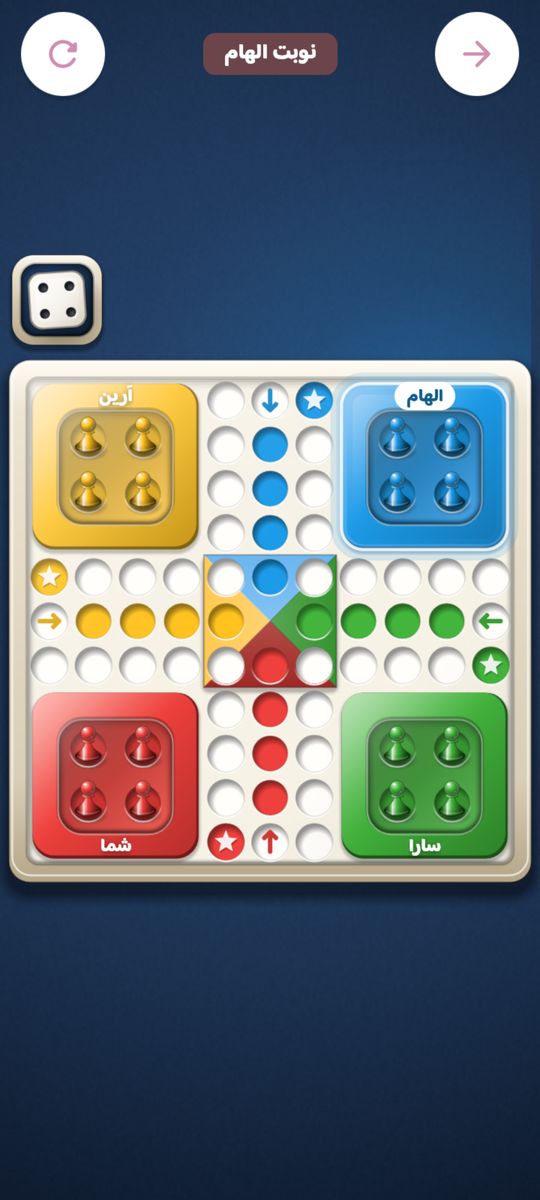
Mensch (منچ) is the Iranian name for the family game known in Germany as Mensch argere Dich nicht and around the world as Ludo, all descended from the old Indian game of pachisi. Each player has four pieces to move once around the board and into the home cells. The die does a lot of the work, but choosing which piece to move and where to stop is what separates winners from losers.
In Hamdor you can play Mensch with two, three or four players, online against real players, in a private room with friends, offline against bots, or together on one phone.
How to play Ludo
- You need a 6 to bring a piece out; a 6 also earns another roll (but three 6s in a row lose the turn).
- With no piece in play you get three tries to roll a 6.
- Land on a rival piece and it goes back to its base.
- You can't land on your own piece, and a piece may not pass the last home cell. First to bring all four into the home cells wins.
These are the exact rules Hamdor plays by; the app shows them too, under each game's How to play tab.
Mensch the Iranian way
- A 6 to come out: a piece leaves the base only on a 6, and every 6 earns another roll; three 6s in a row lose the turn.
- Three tries: with no piece in play you get three rolls to find a 6.
- Knock them home: land on a rival piece and it goes back to its base. You can't land on your own piece.
- Exact finish: a piece may not pass the last home cell. First to bring all four pieces home wins.
- Two, three or four players: in a two-player game the start cells are opposite each other. Online, a bot fills any empty seat.
Ludo modes in Hamdor
- 4 players
- 2 players
- 3 players
Tips to win at Mensch
- Don't stand on a rival's start cell. When they roll a 6 and bring a piece out, anything on that cell is knocked home.
- Watch the six cells behind you. A rival piece one to six cells behind yours can hit it with a single roll. Move out of range when you can.
- A 6 doesn't always mean a new piece. If a 6 lets you hit a rival or save a piece near home, use it there; you still get the extra roll either way.
- Keep two pieces in play. With one piece you must move it whatever you roll; with two you can dodge or attack.
- Secure the far-travelled piece. Home cells are safe. A piece that has gone almost all the way loses the most if it is hit.
- Fill home from the back. Pieces can't pass the last cell or share one, so push the first piece all the way in to leave room for the rest.
Ludo in Hamdor
- Online, ranked: play real opponents and earn a rating. If nobody turns up within a few seconds, a bot takes the seat and is labelled as a bot.
- Private rooms: create a room, send the code to your friends and chat with stickers and reactions while you play.
- Bots: play offline against bots, to practise or when nobody is online.
- Two on one phone: pass the phone and play face to face.
- Stats and streaks: your win rate, best winning streak and this game's leaderboard.
- Your own look: change how the table and pieces look in the Hamdor shop. It is cosmetic only and never affects who wins.
Ludo FAQ
How many players can play Mensch?
Two to four. Hamdor has two-, three- and four-player games, and bots fill any empty seats.
Why do I need a 6?
Under Mensch rules a piece only comes out of its base on a 6. With nothing in play you get three tries to roll one.
Is Mensch the same as Ludo?
They are the same family: race four pieces home and knock rivals back. Hamdor's Mensch uses the familiar Iranian rules: a 6 to come out, an extra roll on a 6, and hit pieces return to base.
Can I play Mensch offline?
Yes, against bots or with friends on one phone. Online play needs a connection.