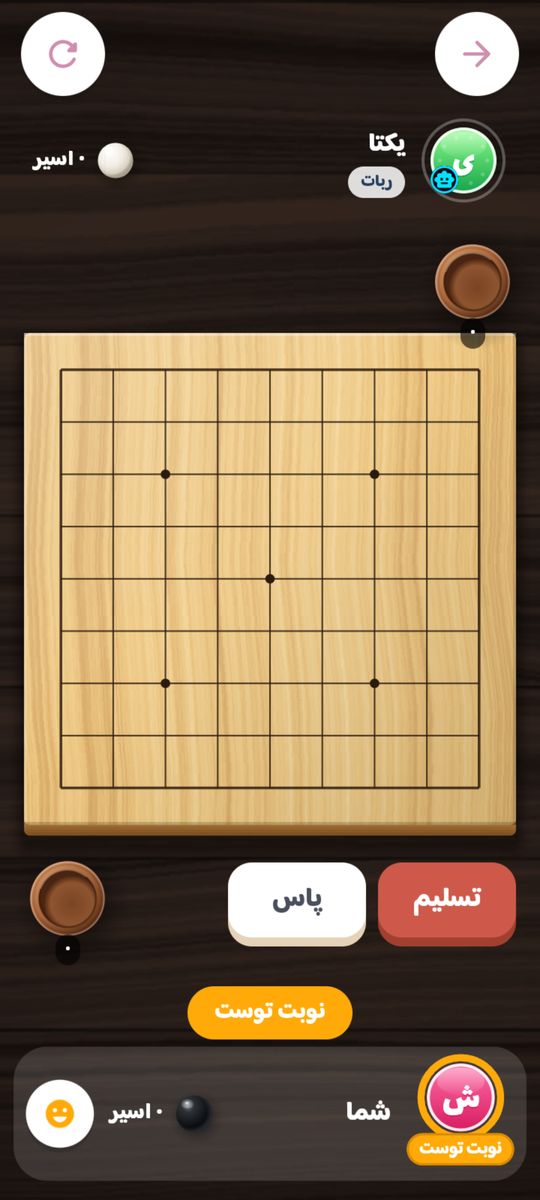
Go, also known as Weiqi or Baduk, is an ancient two-player strategy game from China, played across East Asia for thousands of years. Players take turns placing black and white stones on the intersections of the board. Stones never move; a group is captured only when all its liberties are filled. The rules take minutes to learn, but the game is deep enough to keep improving for a lifetime.
In Hamdor you can play ranked Go online against real players, set up a private room and send the code to a friend, practise offline against a bot, or play a friend on one phone. Hamdor does the counting at the end of the game for you.
How to play Go
- Chinese rules (area scoring). A 9×9, 13×13 or 19×19 board. Black plays first; white gets 7.5 points of komi, so there are no draws.
- Each turn, place a stone on an empty point or pass. Touching stones of one color form a chain; the empty points next to it are its liberties.
- A rival chain whose last liberty you fill is captured and removed. A move that leaves your own chain without liberties and captures nothing (suicide) is not allowed.
- Ko: no move may recreate a whole-board position seen earlier in the game (positional superko). So a stone just captured in a ko can't be retaken at once.
- Two passes in a row end play. Then counting: stones that look dead are marked; either player can tap chains to mark them dead or alive, and once both accept the same marking the game is counted. If you disagree, Play on resumes the game.
- Each color scores its living stones plus the empty points only its stones surround (dead stones count for the other side). The higher score, white's komi included, wins. You may also resign at any time on your turn.
These are the exact rules Hamdor plays by; the app shows them too, under each game's How to play tab.
Go in Hamdor
- Three board sizes: 9×9 for quick games and learning, 13×13 in between and 19×19 for the full game. Online, you are only paired with players who chose the same size.
- Chinese rules: area scoring, counting living stones plus empty points surrounded only by your stones.
- Komi of 7.5: black plays first and white receives 7.5 points, so there are no draws.
- Positional superko: no move may recreate a whole-board position seen earlier in the game.
- Marking dead stones: after two passes in a row both players mark dead stones; once both accept, the game is counted. If you disagree, play resumes.
Go modes in Hamdor
- 9×9 (quick)
- 13×13
- 19×19 (full)
Tips to win at Go
- Corners, then sides, then centre. A corner needs the fewest stones to enclose territory, because two edges of the board do half the work.
- Make two eyes. A group with two separate empty points inside it can never be captured. When a group is under pressure, think about its life first.
- Count liberties. In a close fight, count the liberties of your group and your opponent's. The group with more usually wins.
- Atari is not always good. Threatening a stone only to make your opponent strengthen their group helps them, not you.
- Keep away from strength. Stones played right next to a strong enemy group tend to end up weak. Play at a distance.
- Think about ko threats. You can't retake a ko at once, so first play a threat elsewhere that your opponent must answer.
- Don't pass too early. Under Chinese scoring every living stone is a point, so filling the neutral points between the two colours at the end still counts.
Go in Hamdor
- Online, ranked: play real opponents and earn a rating. If nobody turns up within a few seconds, a bot takes the seat and is labelled as a bot.
- Private rooms: create a room, send the code to your friends and chat with stickers and reactions while you play.
- Bots: play offline against bots, to practise or when nobody is online.
- Two on one phone: pass the phone and play face to face.
- Stats and streaks: your win rate, best winning streak and this game's leaderboard.
- Your own look: change how the table and pieces look in the Hamdor shop. It is cosmetic only and never affects who wins.
Go FAQ
Which board size should I start with?
9×9. Games are short and fights start quickly, so you learn the rules and basic shapes faster. Move on to 13×13 and 19×19 later.
How does a game of Go end?
When both players pass in a row. Dead stones are then marked and each colour is counted. You can also resign at any time on your turn.
What is komi?
Points given to white to make up for moving second. In Hamdor komi is 7.5, and that half point means a game can never be drawn.
Can I play Go offline?
Yes. Play a bot or a friend on one phone without a connection. Online and private-room games need the internet.